

DeCoSEAS aims to produce four digital, open access collections of music and sound from Southeast Asia that are now located in repositories in Europe.
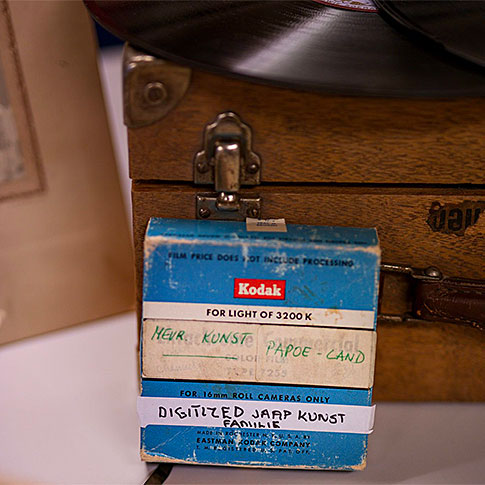
Jaap Kunst Sound Collection
One of the world’s foundational ethnomusicological sound collections recorded in the 1920s and 1930s on the many islands of the Indonesian archipelago. Now located at the University of Amsterdam.
The Jaap Kunst Sound Collection
Curator: PL Barbara Titus (University of Amsterdam, the Netherlands)
Importance: One of the world’s foundational ethnomusicological collections, both with regard to its
materials and the methods of collection. Jaap Kunst (1891-1960) recorded music from the many
islands of the Indonesian archipelago on hundreds of wax cylinders in the 1920s and 1930s. His
collection also encompasses 6,500 photographs, 10,000 letters, silent film, publication manuscripts,
and travel diaries.
Access hurdles: Kunst’s sound collection has been digitized but is not available online. His written
and visual collection is organized, but only partly catalogued and not digitized. Kunst employed
classification norms of the time. Hence, the recorded singers, speakers, ritualists and
instrumentalists often remain anonymous sound specimens of distinct cultures as general and static
entities.
Solutions: DeCoSEAS facilitates physical access to the collection on site [link to Fellowship]. It also
selectively digitizes visual/textual materials for the aim of contextualizing sonic materials. These are
presented online for crowdsourcing, data enrichment and expert community building [link to
Digitization]. Thus, DeCoSEAS relates visual and written material to its sonic counterparts for the
anonymized sound specimens to gain personhood.

BBC Empire Service in SE Asia
Recorded broadcasts of formative political events and the every-day lives of people in the British imperial sphere during late colonial and early postcolonial eras (1930s-1950s). Now located at the BBC Archive Trust and the British Library.
The BBC Empire Service in SE Asia
Investigator: PI Cristina Martinez-Juan (SOAS, University of London)
Importance: BBC Archive Trust and British Library (BL) hold a diversity of recorded broadcasts that
make us hear the formative political events as much as the every-day lives of people within and
outside the British imperial sphere during late colonial and early postcolonial eras (1930s-1950s).
These range from Cantonese opera concerts in Singapore to Indonesian president Sukarno’s
Independence Speech, and reports on European World War II refugees in Southeast Asia. The
material attends to voices that are not necessarily represented in written historiographies.
Access hurdle(s): The Southeast Asian records are part of larger overseas recorded radio repertoires.
Whereas the metadata of the sound recordings are at the British Library, the recordings themselves
are predominantly at the BBC. This makes it difficult to ascertain the context, role and significance of
the recorded broadcasts.
Solutions: DeCoSEAS selects the Southeast Asian digitized broadcasts from the larger body of
overseas recordings for the aim of contextualizing sonic materials. These are presented online for
crowdsourcing, data enrichment and expert community building [Digitization]. It also facilitates physical access to the material on site [Fellowships].
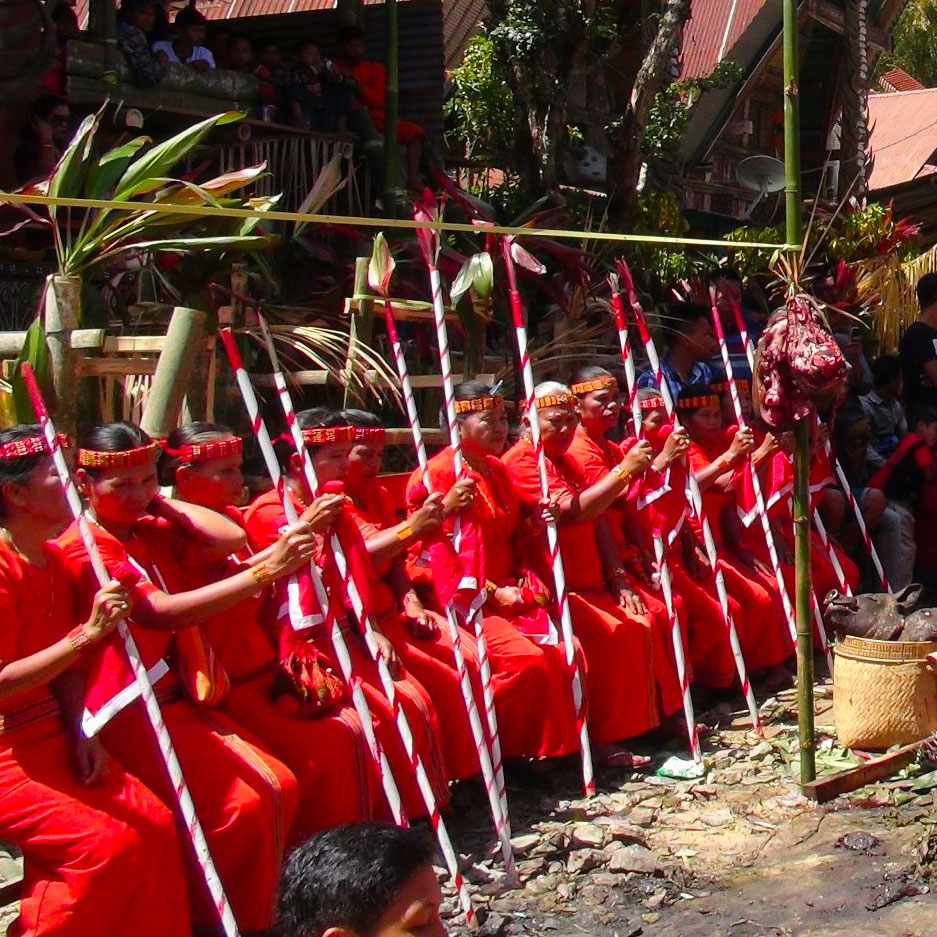
Penanian, Toraja ritual music
A unique multimedia study of the ritual music of the Toraja people in Sulawesi with 40 hours of songs and poems with photographs and video recorded between 1991 and 2005 by Dana Rappoport.
Penanian, Toraja ritual music
Curator: Dana Rappoport (Centre Asie du Sud Est [CASE] – CNRS)
Importance: Songs of the Thrice-Blooded Land, recorded by Rappoport between 1991 and 2005, is a unique multimedia study of the ritual music of the Toraja people in Sulawesi – musical heritage that belongs to Austronesian cultural stratum established in Indonesia around 3000 BCE and is now on the brink of extinction. It presents an entire ritual cycle: 40 hours of songs and poems, translated into three languages (Indonesian, English, French) and accompanied by extensive documentary material (2000 photographs and 120 minutes of video).
Access hurdles: The multimedia DVD-Rom has become an obsolete medium. Now, the material is accessible on Penanian
Solution: DeCoSEAS team migrated these materials from DVD-Rom to an open-access website [see Penanian], serving as a technical model for the conservation and sharing of intangible sound heritage.
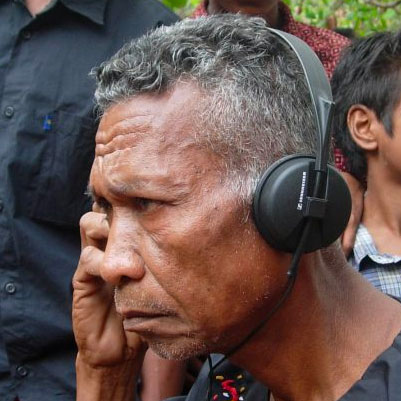
Pratinada, Hearing Southeast Asia
A digital platform aggregating the newly disclosed collections with access to other digital sound archives in Southeast Asia and Europe.
Pratinada, Hearing Southeast AsiaPratinada.net is a multilingual digital platform that provides access to formative collections with music and sound from Southeast Asia that are currently located in Europe. In providing this digital access to more than 7000 recordings, DeCoSEAS conceptualizes – in partnership with scholars, artists, local societies from Southeast Asia – a new digital curational framework to optimize the most relevant parameters for open access and user-friendliness.
The portal aggregates the data and metadata of the Collections from France (CNRS, BnF,…), Jaap Kunst Collection and the BBC Empire Service broadcasts in a common model designed for interaction with external contributors. The user interface is available in 9 languages, including 7 from Southeast Asia, for better understanding and sharing. This enables stakeholders in Southeast Asia with an internet connection to consult the material and enrich the collections’ metadata. Moreover, the platform enables the exchange of knowledge and ideas between stakeholders in Southeast Asia and diasporic communities either in Europe or elsewhere, transferring curatorial agency to these stakeholders.
The platform executes DeCoSEAS’ vision adopting a knowledge chain with three formative orientation points: the improvement of access to heritage, the transfer of agency to stakeholders of heritage, and the diversification of the dialogue about heritage curation.